If you’ve started shopping for a new air conditioner recently, you’ve probably run into a number that wasn’t part of the conversation a few years ago: SEER2. Maybe a contractor mentioned it on a quote, maybe you noticed the efficiency rating on a new unit looks lower than the one on your old system, or maybe you’re just trying to figure out what the number even means before you spend several thousand dollars. None of that confusion means you’re missing something obvious. The way air conditioners are tested changed in 2023, and understanding that shift is what separates someone who picks a genuinely energy efficient air conditioning system from someone who just picks the unit with the biggest number on the spec sheet.
This guide covers what SEER2 actually measures, why the numbers changed, what rating makes sense for homes in Cincinnati and Northern Kentucky, how SEER2 compares to the old SEER scale, what actually affects real world efficiency beyond the label, and the questions worth asking before you commit to any new system.
What Does a SEER2 Rating Actually Measure
SEER2 stands for Seasonal Energy Efficiency Ratio 2. Like the original SEER rating, it measures how much cooling a system produces over a typical season compared to how much electricity it consumes to produce it. The higher the number, the more cooling you get per unit of energy spent. In simple terms, a higher SEER2 rating means the system is doing more work with less electricity.
The difference between SEER and SEER2 comes down to testing conditions, not the underlying concept. Before 2023, air conditioners were tested in a way that didn’t reflect how a system performs once it’s actually connected to ductwork in a real home. The old test used a much lower external static pressure than what most homes actually experience, especially once you factor in air filters, duct bends, and ductwork that isn’t perfectly sized for the system. SEER2 testing increased that static pressure significantly, roughly five times higher than the old standard, so the number on the label now reflects something closer to how the system will actually perform once it’s installed.
That single change in testing methodology means a system tested under SEER2 will almost always show a lower number than the exact same physical equipment would have shown under the old SEER test. This is the part that trips up a lot of homeowners, and it’s worth sitting with for a second, because it changes how you should be comparing any efficient AC system on the market today.
Why the New Numbers Look Lower, and Why That’s Not a Bad Thing
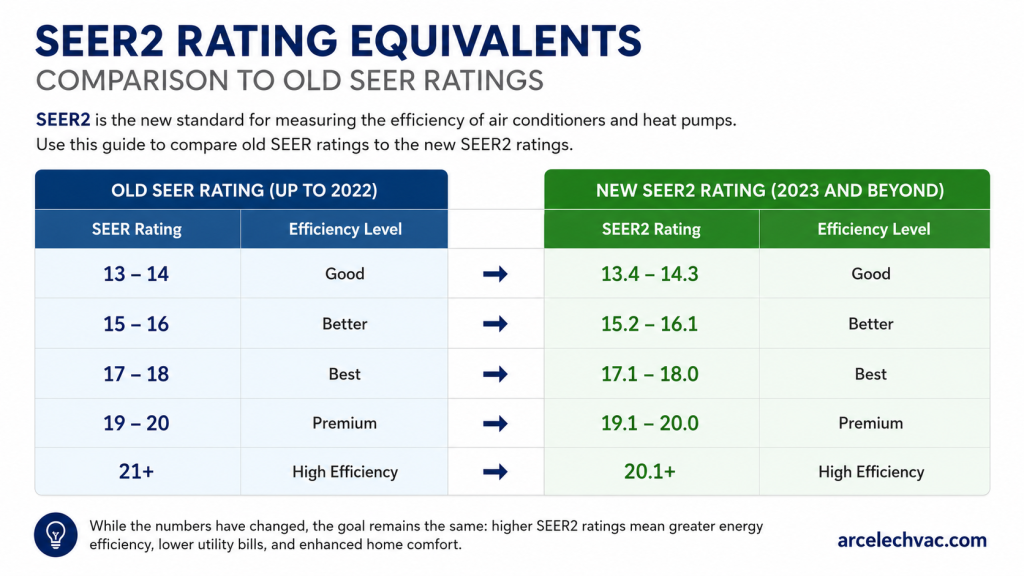
Here’s where confusion usually sets in. Say your old unit was rated 16 SEER, and a contractor quotes you a new system rated 15 SEER2. The instinct is to assume you’re being downgraded, or that the industry somehow got worse at building air conditioners. Neither is true.
As a rough guide, a 14 SEER unit under the old testing standard lines up closely with a 13.4 SEER2 rating under the new one. A 15 SEER unit is roughly equivalent to 14.3 SEER2. The equipment itself has generally improved over the years. What changed is that the test got stricter about proving real world performance instead of allowing manufacturers to report numbers generated under near ideal lab conditions.
Once you understand that the scale itself shifted, comparing quotes for an energy efficient air conditioning system becomes a lot less confusing. You stop assuming a lower number automatically means worse equipment, and you start asking the more useful question: is this rating actually being applied correctly to my home.
What SEER2 Rating Is Actually Required in Cincinnati and Northern Kentucky
The Department of Energy divides the country into three efficiency regions for minimum standards: North, Southeast, and Southwest. Greater Cincinnati and Northern Kentucky both fall into the North region, which carries the lowest minimum efficiency requirement in the country. For standard split system central air conditioners here, that minimum sits at 13.4 SEER2.
It’s important to treat that number as a floor, not a target. It’s the lowest rating legally allowed for new equipment sold here, not the most efficient option available to you. Plenty of systems installed in this region run well above that baseline, commonly in the 15 to 18 SEER2 range for standard residential installs, and higher still for households that run cooling heavily or are dealing with high electric rates.
Because the North region’s minimum is lower than what’s required in the Southeast or Southwest, some homeowners assume efficiency matters less here. That assumption doesn’t hold up against actual summer conditions. Cincinnati and Northern Kentucky summers get humid and demanding enough that the difference between a 14 SEER2 system and an 18 SEER2 system shows up clearly on a July or August electric bill, regardless of what the legal minimum technically requires. Regional minimums are about compliance. Your actual utility bill is about how the system performs in your specific house, on the specific days you need it most.
SEER vs SEER2: Why the Comparison Still Trips People Up During Quotes
It helps to think of SEER and SEER2 as the same basic idea measured with two different rulers, one considerably more forgiving than the other. Both describe cooling efficiency over a season. The difference is entirely in how realistic the testing conditions are.
This becomes a practical issue at the quoting stage. If a contractor compares a new system’s SEER2 rating directly against a competitor’s old style SEER number to make one option look worse than it actually is, that comparison isn’t honest, even if it isn’t necessarily intentional. Every air conditioner manufactured and sold today should carry a SEER2 rating, since that’s the current standard set by the DOE. If someone quotes you an old SEER number for equipment that was clearly manufactured recently, it’s worth asking directly which scale they’re using and why. A straightforward answer to that question is usually a decent signal that you’re dealing with someone who explains things accurately rather than someone trying to make a particular option look better by comparing it against the wrong baseline.
How to Read a SEER2 Rating Correctly Before You Commit to Anything
There are a few things worth confirming before signing off on any efficient AC system, and none of them are complicated once you know to ask.
First, check whether the rating you’re being quoted applies to the full matched system or just the outdoor condenser. SEER2 ratings are calculated based on the outdoor unit and indoor coil working together as a pair. If a high efficiency condenser gets paired with an older or mismatched indoor coil, real world performance can drop noticeably below the number on the brochure. In the industry, this is sometimes referred to separately as a coil only rating, and it matters because two contractors quoting what sounds like the “same” SEER2 number might actually be describing very different equipment configurations.
Second, ask what the rating assumes about your home’s ductwork. SEER2 testing already builds in a more realistic static pressure than the old SEER test did, but a home with leaky, undersized, or poorly laid out ductwork can still underperform its labeled rating by a meaningful margin. If your ductwork hasn’t been inspected in years, that’s worth addressing before you assume a higher rated system will automatically deliver the savings implied by its label.
Third, resist the urge to assume the highest available SEER2 number is automatically the smartest purchase. A high efficiency unit installed in a home without a proper cooling load calculation, with poor duct sealing, or with weak attic insulation, won’t deliver the performance suggested by its rating. The number on the label and the actual performance inside your walls are related, but they are not guaranteed to match unless the rest of the system is set up to support it.
Is Paying More for a Higher SEER2 Rating Actually Worth It
Not automatically, and this is where a lot of otherwise good advice oversimplifies things. Higher rated systems generally cost more upfront. Whether that additional cost pays off over time depends heavily on how many hours a year your air conditioner actually runs, your local electric rates, and how long you’re planning to stay in the home.
For a household running cooling heavily for four or five months out of the year, moving from a 14 SEER2 system to a 17 or 18 SEER2 system can realistically pay for itself well within the equipment’s expected lifespan, often somewhere in the ten to fifteen year range depending on usage. For a smaller home with lighter seasonal usage, or for someone who might move within a few years, that same upgrade might take longer to break even than the unit is expected to last, which changes the math considerably.
This is exactly why a proper cooling load calculation, sometimes called a Manual J calculation, and an honest look at your actual usage pattern matter more than simply chasing the highest number available on a spec sheet. A system that’s correctly sized and matched to your home will often outperform an oversized, higher rated system that was installed based on square footage alone.
It’s also worth factoring in available rebates and tax incentives when weighing the upfront cost difference. Many utility companies and manufacturers offer rebates tied specifically to higher SEER2 tiers, and federal tax credits have periodically applied to qualifying high efficiency equipment. These incentives can meaningfully shorten the payback period on a higher rated system, so it’s worth asking specifically what’s available in Ohio and Kentucky at the time you’re buying, since these programs change from year to year.
A Few Common Myths Worth Clearing Up
One persistent myth is that a higher SEER2 number always means a quieter, longer lasting system. Efficiency rating and equipment durability are related to some degree, since higher efficiency units often use variable speed compressors and better components, but they aren’t the same measurement. It’s entirely possible to have two systems with the same SEER2 rating that differ meaningfully in noise level, build quality, and expected service life.
Another common misconception is that once you buy a high SEER2 rated system, the efficiency is locked in for good. In reality, efficiency degrades over time without regular maintenance. Dirty coils, low refrigerant charge, clogged filters, and neglected ductwork can all pull real world performance well below the labeled rating within just a few years. A system installed at 17 SEER2 that never gets serviced can easily perform closer to a poorly maintained 13 or 14 SEER2 unit within a decade. The rating on the label describes the system’s potential when installed and maintained correctly, not a permanent guarantee.
Questions Worth Asking Before You Buy
A short list of questions tends to separate a genuinely good decision from a costly one down the road.
Does this SEER2 number reflect the full matched system, including the indoor coil, or only the outdoor condenser on its own?
Has my home’s actual cooling load been calculated specifically, or is this recommendation based on square footage alone without a proper assessment?
Given how many hours a year I actually run my AC, what’s the realistic payback period on the higher efficiency option compared to a standard one?
Can my current ductwork actually support this rating, or does it need sealing, resizing, or repair first to deliver what the label promises?
Are there any current utility rebates or tax credits available for this specific efficiency tier in Ohio or Kentucky right now?
If a contractor can’t answer these clearly and directly, treat that as useful information in itself. A SEER2 rating only means something once it’s correctly matched to your specific house, your ductwork, and how you actually use your system.
Picking the right SEER2 rating isn’t about finding the biggest number you can afford or the one that sounds most impressive on a proposal. It’s about matching real, measurable performance to how your home actually uses cooling, so the efficiency you’re paying for shows up consistently on your utility bill year after year, not just on a spec sheet the day it’s installed.
If you’re ready to find the right SEER2 rated system for your home, explore our air conditioning installation services here for a straightforward assessment from a certified technician or call us directly at (859) 441-7161 to get your home’s actual cooling needs evaluated properly before you buy anything.

