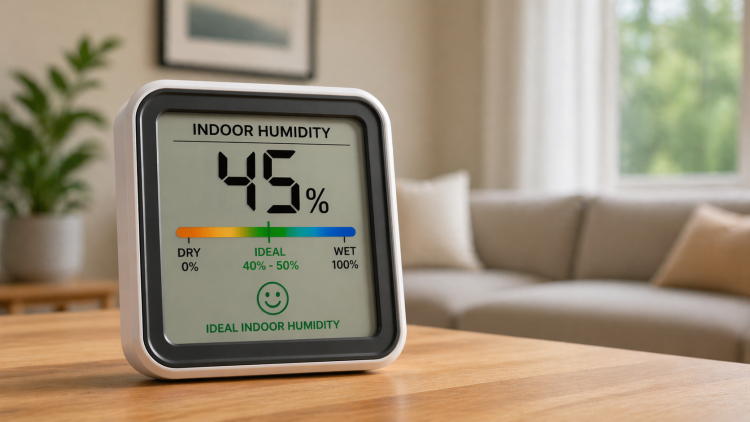
Most people think about temperature when their home feels uncomfortable. Too hot, turn on the AC. Too cold, bump up the heat. But temperature is only half the story. The moisture in your air, your indoor humidity level, plays just as big a role in how comfortable you feel, how healthy you stay, and even how much you pay on your energy bill every month.
In Cincinnati and Northern Kentucky, this is not a small issue. The region swings hard between humid summers that make 80 degrees feel like 95, and brutally dry winters where your forced-air heating system strips nearly every drop of moisture from your indoor air. If your home has ever felt stuffy and sticky in July or left you waking up with a dry throat and cracked lips in January, your indoor humidity is the culprit.
This article breaks down exactly what healthy indoor humidity looks like, what happens when levels go too high or too low, and what you can actually do to bring your home into the right range.
What Is Indoor Humidity and Why Does It Matter
Humidity is the amount of water vapor present in the air. When we talk about indoor humidity, we usually refer to relative humidity, expressed as a percentage. A reading of 50% relative humidity means the air is holding half of the maximum water vapor it could hold at that temperature.
That number matters more than most homeowners realize. Air that is too dry pulls moisture from everything it touches, including your skin, your sinuses, your wood floors, and your furniture. Air that holds too much moisture creates the conditions that mold, dust mites, and bacteria need to thrive. Both extremes put stress on your body and your home.
Your HVAC system sits at the center of this equation. A properly functioning system does not just heat and cool your air. It also manages moisture. When that balance breaks down, the humidity problem is rarely far behind.
What Is the Ideal Indoor Humidity Level
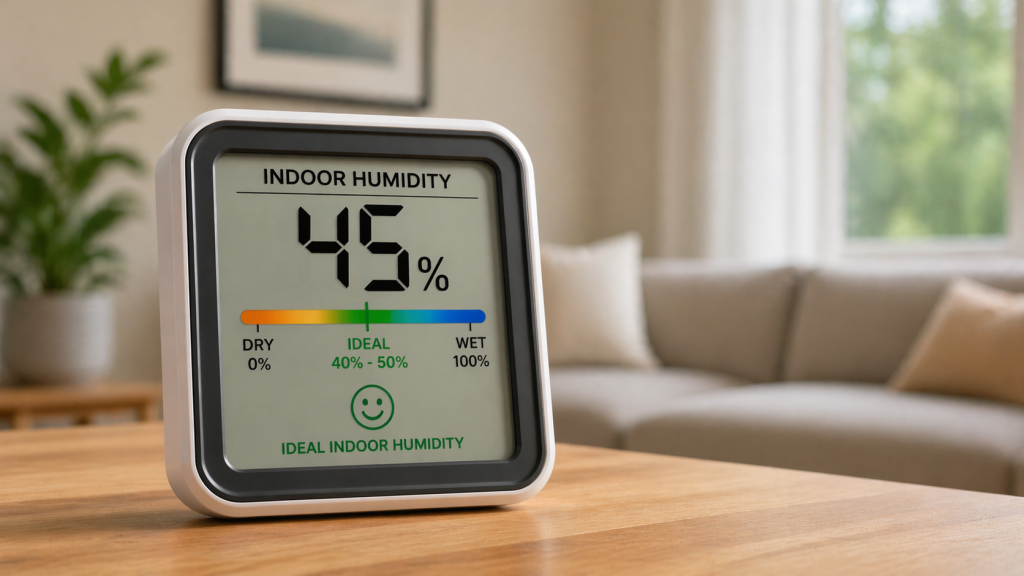
According to the American Society of Heating, Refrigerating and Air-Conditioning Engineers (ASHRAE), the recommended indoor relative humidity range for health and comfort is between 30% and 60%, with the sweet spot sitting between 40% and 50%.
That range is not arbitrary. Research consistently shows that staying within 40 to 50 percent relative humidity reduces the survival rate of airborne viruses, limits mold growth, controls dust mite populations, and minimizes respiratory irritation. It is also the range in which most people simply feel most comfortable, without air feeling either stale and heavy or dry and scratchy.
In practical terms for Cincinnati homeowners, this means targeting around 45% relative humidity year-round, adjusting slightly lower in winter to prevent condensation on your windows, and slightly higher in summer if your AC is over-drying the air.
When Indoor Humidity Gets Too High
High indoor humidity is a summer problem for most homes in the Greater Cincinnati area, though it can persist year-round in poorly ventilated homes, basements, and older properties without proper HVAC balance.
Anything consistently above 60% relative humidity creates problems. Here is what that looks like in practice.
Mold and mildew growth. Mold does not need much. A surface, some organic material, and moisture above 60% relative humidity is enough to get it started. Once mold takes hold in a wall cavity, under flooring, or in your ductwork, you have a much bigger problem than humidity alone.
Dust mite explosion. Dust mites thrive between 70% and 80% relative humidity. These microscopic insects are one of the most common household allergens, and high humidity is essentially a breeding invitation.
That sticky, heavy feeling. High humidity makes your body less efficient at cooling itself through perspiration. The air already holds so much moisture that sweat cannot evaporate properly. This is why 80 degrees at 70% humidity feels far worse than 80 degrees at 45%.
Structural damage. Wood absorbs moisture from the air. Over time, high indoor humidity warps hardwood floors, swells door frames, peels paint, and compromises the structural integrity of wood components throughout your home.
Higher energy bills. Your air conditioner works harder when it has to remove excess moisture from the air in addition to cooling it. An oversized or poorly maintained AC unit often makes this worse by cooling the air too quickly without running long enough to properly dehumidify it.
Signs your indoor humidity is too high:
- Condensation on windows and mirrors that does not clear quickly
- A persistent musty smell, especially in basements and bathrooms
- Visible mold spots on walls, ceilings, or grout lines
- Warping or buckling in wood floors or furniture
- Allergy symptoms that are worse indoors than outside
When Indoor Humidity Gets Too Low
Low indoor humidity is the winter problem, and in Cincinnati it hits hard. When temperatures outside drop and your furnace kicks into high gear, it heats the air inside your home without adding any moisture back in. The result is air that can drop to 20% or 30% relative humidity, well below the healthy range.
Anything consistently below 30% causes its own set of problems.
Respiratory irritation. Your sinuses, throat, and lungs rely on mucous membranes to filter air and fight infection. Dry air dries those membranes out, reducing their effectiveness and leaving you more vulnerable to colds, flu, and respiratory infections. This is one reason people get sick more often in winter, not just because of the cold outside, but because of the dry air inside.
Dry skin and static electricity. Cracked hands, chapped lips, and itchy skin in winter are not just about cold weather. Low indoor humidity strips moisture from your skin constantly. The same dry conditions that cause static electricity throughout your home tell you the air needs more moisture.
Damage to wood and finishes. Just as high humidity swells wood, low humidity shrinks it. This causes gaps in hardwood floors, cracking in wood furniture, splitting in trim and cabinetry, and damage to musical instruments. If you have a piano, a guitar, or hardwood floors you care about, low indoor humidity is a real threat.
Increased heating costs. Humid air holds heat better than dry air. When your indoor humidity is too low, the same temperature actually feels colder, which causes many homeowners to push the thermostat higher. Raising your indoor humidity to a healthy level can make 68 degrees feel as comfortable as 72, which adds up to real savings over a heating season.
Signs your indoor humidity is too low:
- Waking up with a dry or sore throat
- Frequent nosebleeds, especially in children
- Skin that feels tight, itchy, or visibly dry
- Increased static electricity throughout the home
- Gaps appearing between hardwood floor planks
- Houseplants looking stressed or dropping leaves
How to Fix Indoor Humidity Problems
Understanding the problem is one thing. Fixing it is another. The good news is that most indoor humidity issues have practical, lasting solutions, and many of them connect directly to your existing HVAC system.
Get a Hygrometer First
Before you do anything else, buy a hygrometer. This is a simple, inexpensive device that measures relative humidity. You can find basic ones for under $20. Place one in your main living area and one in your bedroom. Check them over several days, across different weather conditions. Once you know your actual numbers, you can make informed decisions instead of guessing.
Fixing High Indoor Humidity
Make sure your AC is the right size. An oversized air conditioner is one of the most common causes of persistently high indoor humidity in the summer. It cools your home so fast that it short-cycles, meaning it turns off before it runs long enough to pull adequate moisture from the air. If your AC runs in short bursts and your home still feels humid, this is worth having an HVAC technician evaluate.
Use exhaust fans. Cooking, showering, and even breathing add moisture to your indoor air. Running bathroom and kitchen exhaust fans during and after these activities helps push that moisture outside before it raises your overall humidity levels.
Consider a whole-home dehumidifier. Portable dehumidifiers work for single rooms, but they are noisy, require constant emptying, and often struggle to keep up with a whole house. A whole-home dehumidifier integrates directly into your HVAC system, runs quietly, drains automatically, and maintains consistent humidity throughout every room.
Check your home’s ventilation and sealing. Moisture intrusion from crawl spaces, basements, and poorly sealed foundations is a major contributor to high indoor humidity in older Cincinnati homes. A vapor barrier in the crawl space and proper sealing around foundation penetrations can make a significant difference.
Fixing Low Indoor Humidity
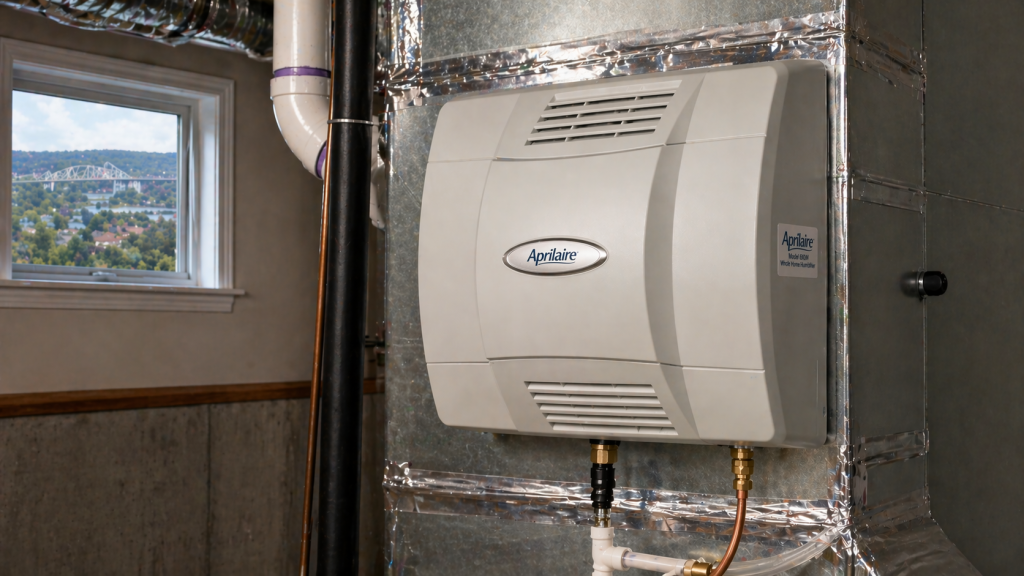
Install a whole-home humidifier. This is the most effective long-term solution for dry indoor air in winter. Unlike portable humidifiers that only treat one room and require frequent refilling and cleaning, a whole-home humidifier connects directly to your furnace and water supply. It automatically introduces the right amount of moisture into your heated air as it circulates through your home.
At Arc Electric, we install Aprilaire whole-home humidifiers, including the Aprilaire Model 600, a bypass unit that uses your furnace blower to move air through a water panel. It monitors both indoor and outdoor humidity and adjusts automatically to maintain your target level. One unit, no buckets, no portable devices in every room, and consistent humidity throughout your entire home.
Check your furnace filter. A clogged filter restricts airflow, which reduces your system’s ability to distribute both heat and humidity effectively. Replacing your filter regularly is one of the simplest maintenance steps that impacts overall system performance.
Seal air leaks. Cold dry air infiltrating your home in winter through gaps around windows, doors, and utility penetrations forces your system to work harder and contributes to low humidity by constantly introducing unconditioned outside air. Weatherstripping, caulking, and proper insulation help your home hold the moisture you add in.
How Your HVAC System Affects Indoor Humidity Year-Round
It is worth stepping back and looking at the bigger picture here, because your HVAC system is the primary driver of your indoor humidity levels whether you realize it or not.
In summer, your air conditioner removes humidity as a byproduct of cooling. The refrigerant coil inside your air handler gets cold enough that water vapor in the passing air condenses on it, just like condensation forms on a cold glass. That water drains away, taking humidity with it. When your AC is properly sized and maintained, this process keeps your indoor humidity in check naturally.
In winter, your furnace heats air without adding any moisture. The more it runs, the drier your indoor air gets. A whole-home humidifier corrects this by integrating into the system so that moisture is added back in proportion to how much heating is happening.
When either system is the wrong size, poorly maintained, or operating without the right accessories, humidity control suffers. Regular HVAC maintenance is not just about keeping your system running. It directly affects your indoor air quality and humidity management as well.
A Note on Humidity and Health in Cincinnati Specifically
Greater Cincinnati and Northern Kentucky sit in a climate zone that makes humidity management genuinely challenging. Summers bring humid air masses from the south and west that push outdoor humidity above 70% regularly. Winters drop outdoor humidity sharply, and the region’s older housing stock, much of it built before energy-efficient construction was standard, tends to leak air and struggle with both moisture intrusion in summer and dry air in winter.
If you live in an older home in the area, or a home with a crawl space or unfinished basement, you are dealing with compounding factors. The solution is not one product. It is a system approach: a properly sized and maintained HVAC system, the right humidity control accessories, and a home envelope that keeps outdoor conditions from overwhelming your indoor ones.
The Bottom Line
Healthy indoor humidity sits between 40% and 50% relative humidity. Below 30% and you are dealing with dry air that irritates your respiratory system, damages your home, and quietly raises your heating costs. Above 60% and you are inviting mold, dust mites, structural damage, and that miserable sticky feeling that no amount of air conditioning seems to fix.
The fix is rarely complicated. Get a hygrometer, find out where you actually stand, and then address the root cause. For most Cincinnati and Northern Kentucky homeowners, that means pairing a well-maintained HVAC system with a whole-home humidifier for winter and ensuring your air conditioner is properly sized and functioning for summer.
If you are not sure where your home stands or what the right solution looks like, that is exactly the kind of problem we have been solving since 1953 without a sales commission in sight. Explore our humidifier services here to learn how a whole-home humidifier can bring your indoor humidity into the healthy range, or call us at (859) 441-7161 to talk it through with someone who will give you a straight answer, not a sales pitch.

